近期,我校能源动力学院硕士研究生胡康(一作),教师孙慧(通讯)等研究成果“Coupled fault diagnosis for centrifugal pumps through Boruta-Shap feature selection and rime-enhanced stacked denoised autoencoder”在《Engineering Applications of Artificial Intelligence》(中科院一区,Top期刊)(IF=8)上发表。
论文简介如下:
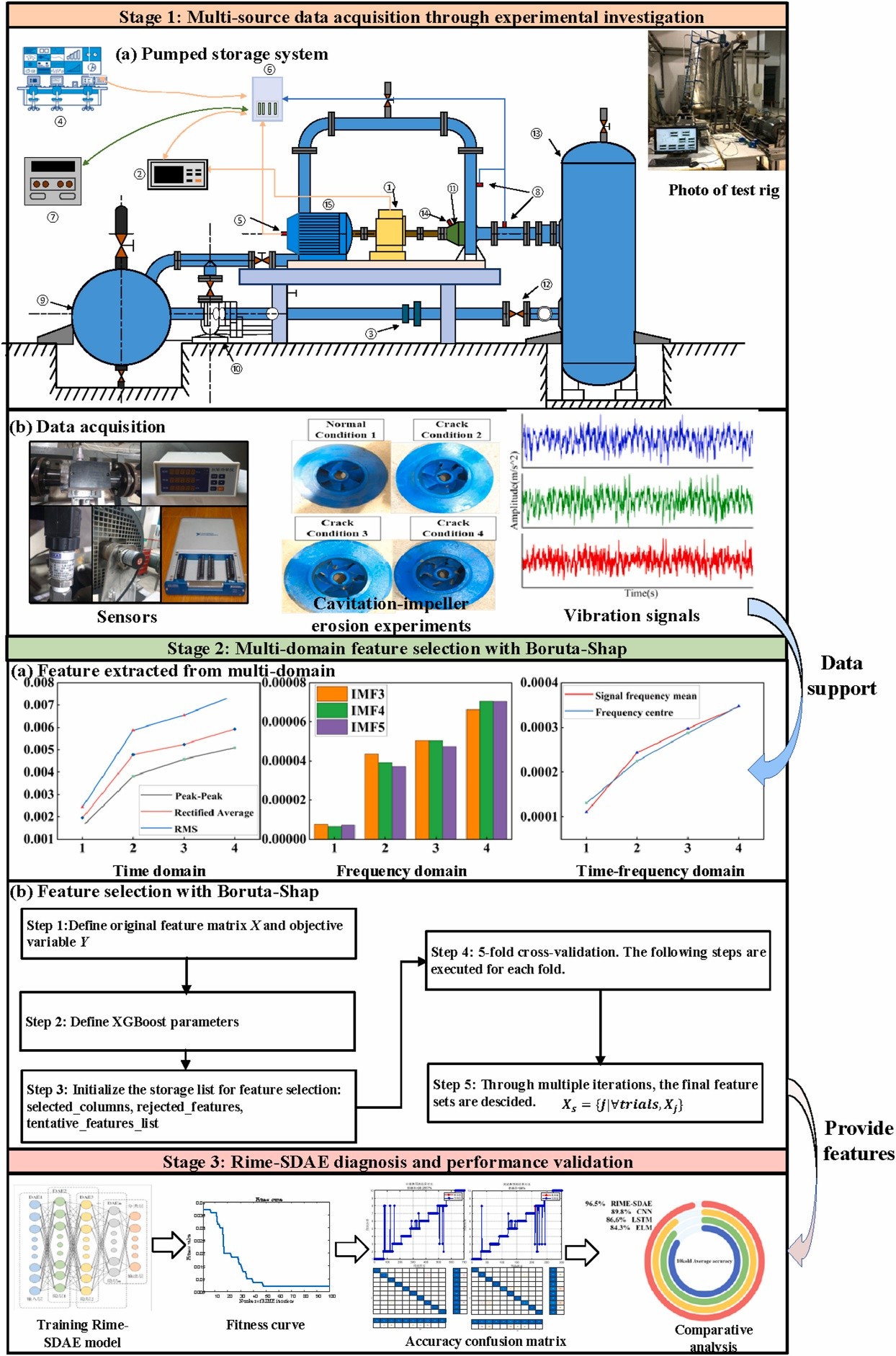
本研究解决了深海离心泵中多条件空蚀和叶轮侵蚀损伤的关键工程挑战,传统方法在这些领域存在特征冗余和泛化能力不足的问题。通过将Boruta-Sap可解释特征选择与Rime优化的堆叠去噪自动编码器(SDAE)集成,提出了一个由人工智能(AI)驱动的框架。首先,振动信号经历多域特征提取。Boruta-Shap 方法通过沙普利值和阴影特征假设检验来量化特征相互作用,从而实现基于物理的空蚀能量指示器和叶轮损伤瞬态特征的选择,从而降低约70%的特征维度。其次,受冰晶生长动力学启发的Rime算法,通过平衡软霜探索和硬霜开采,全球优化SDAE超参数。在可变条件下(0.8、1.0和1.2Q)下进行了实验验证d该框架实现了96%的测试准确率,优于其他诊断模型,且减少了交叉病症错误分类。通过将可解释的人工智能与多物理诊断相结合,这项工作为能源基础设施的预测性维护提供了可复制的解决方案,推动了面对复杂水动力扰动的工业系统智能维护技术的发展。
This study addresses the critical engineering challenges of diagnosing multi-condition cavitation and impeller erosion damage in deep sea centrifugal pumps, where traditional methods suffer from feature redundancy and poor generalization. An artificial intelligence (AI)-driven framework is proposed by integrating Boruta-Shap interpretable feature selection with a Rime-optimized Stacked Denoising Auto-Encoder (SDAE). Firstly, vibration signals undergo multi-domain feature extraction. The Boruta-Shap method quantifies feature interactions via Shapley values and shadow feature hypothesis testing, enabling physics-informed selection of cavitation energy indicators and impeller damage transient features, reducing feature dimensionality by approximately 70 %. Secondly, the Rime algorithm, inspired by ice-crystal growth dynamics, globally optimizes SDAE hyperparameters via balancing soft-rime exploration and hard-rime exploitation. Validated experimentally under variable conditions (0.8, 1.0 and 1.2Qd), the framework achieves 96 % testing accuracy, outperforming other diagnostic models, with reduced cross-condition misclassification. By bridging interpretable AI with multi-physics diagnostics, this work provides a replicable solution for predictive maintenance of energy infrastructure, advancing intelligent maintenance technologies for industrial systems facing complex hydrodynamic perturbations.